
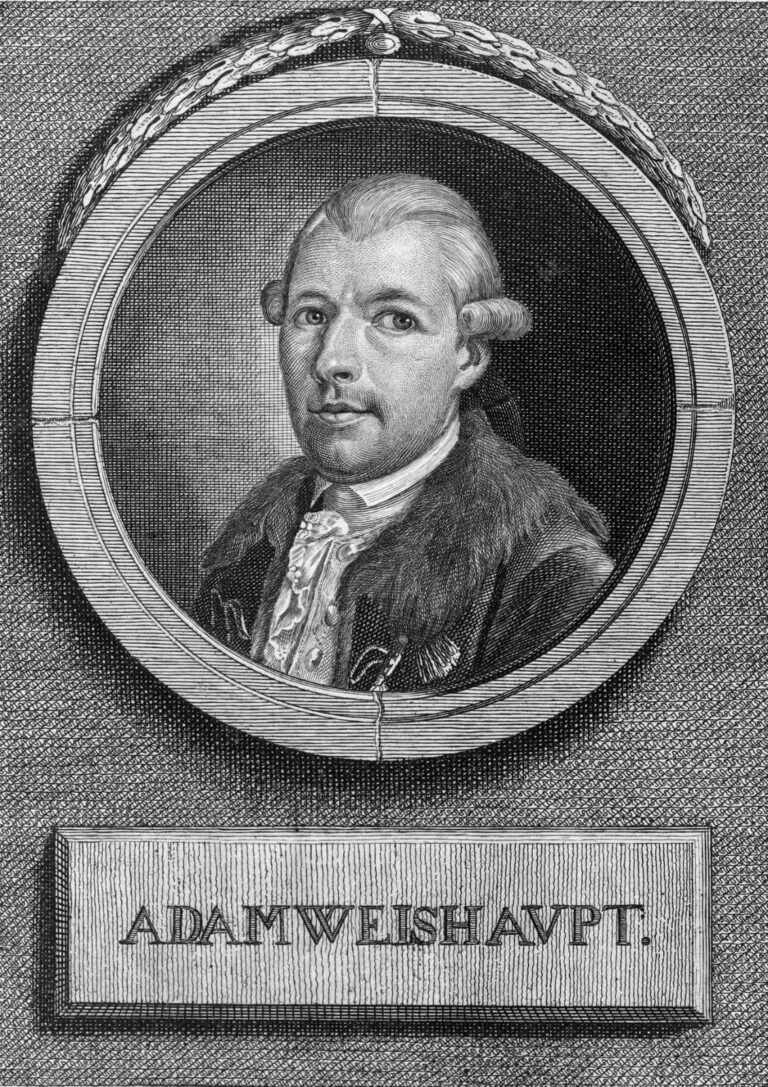
JOHANN ADAM WEISHAUPT
The 18th-century German thinker Johann Adam Weishaupt would have been stunned if he had known his ideas would one day fuel global conspiracy theories, and inspire best-selling novels and blockbuster films. Until he was 36, the vast majority of his compatriots would have been equally stunned to discover that this outwardly respectable professor was a dangerous enemy of the state, whose secret society, Illuminati, was seen to threaten the very fabric of society.
Born in Ingolstadt, a city in the Electorate of Bavaria [Germany], Adam Weishaupt was a descendant of Jewish converts to Christianity. Orphaned at a young age, his scholarly uncle took care of his education, and enrolled him in a Jesuit school. After completing his studies, Adam Weishaupt became a professor of natural and canon law at the University of Ingolstadt, married, and started a family. On the surface, it was a conventional enough career until 1776 when the Bavarian state learned of his incendiary ideas.
A closer look at his upbringing, however, reveals that Adam Weishaupt always had a restless mind. As a boy he was an avid reader, consuming books by the latest French Enlightenment philosophers in his uncle’s library. Bavaria at that time was deeply conservative and Catholic. Adam Weishaupt was not the only one who believed that the monarchy and the church were repressing freedom of thought. Convinced that religious ideas were no longer an adequate belief system to govern modern societies, he decided to find another form of “illumination,” a set of ideas and practices that could be applied to radically change the way European states were run.
Adam Weishaupt was not, he said, against religion itself, but rather the way in which it was practiced and imposed. His thinking, he wrote, offered freedom “from all religious prejudices; cultivates the social virtues; and animates them by a great, a feasible, and speedy prospect of universal happiness.” To achieve this, it was necessary to create “a statue of liberty and moral equality, freed from the obstacles which subordination, rank, and riches, continually throw in our way.”
Over the following years, Adam Weishaupt’s secret order grew considerably in size and diversity, possibly numbering 367 members by 1782. They included important people in Bavarian public life, such as Baron Adolph von Knigge. Although, at first Illuminati was limited to Adam Weishaupt’s students, the membership expanded to include noblemen, politicians, doctors, lawyers, businessmen and jurists, as well as intellectuals and some leading writers, including Johann Wolfgang von Goethe. Baron von Knigge played a very considerable role in the society’s organisation and expansion. As a former Freemason, he was in favor of adopting rites similar to theirs. Members of the Illuminati were given a symbolic “secret” name taken from classical antiquity: The membership levels also became a more complex hierarchy.
How did a Bavarian professor end up creating a group that would be at the center of two centuries of conspiracy theories?
The 18th-century German thinker Adam Weishaupt would have been stunned if he had known his ideas would one day fuel global conspiracy theories and inspire best-selling novels and blockbuster films.
Until he was 36, the vast majority of his compatriots would have been equally stunned to discover that this outwardly respectable professor was a dangerous enemy of the state, whose secret society, the Illuminati, was seen to threaten the very fabric of society. Adam
Weishaupt was a descendant of Jewish converts to Christianity. Orphaned at a young age, his scholarly uncle took care of his education and enrolled him in a Jesuit school. After completing his studies, Adam Weishaupt became a professor of natural and canon law at the University of Ingolstadt, married, and started a family. On the surface, it was a conventional enough career—until 1784 Secret papers seized by the Bavarian authorities revealed fascinating details about the rituals of the Illuminati. A novice preparing to pass to the higher level of minerval, for example, had to present a detailed report on the titles of the books he owned, the identity of his enemies, and the weak points of his character. Upon initiation as a minerval, he promised to sacrifice all personal interests to those of the society. When the Bavarian state learned of his incendiary ideas.
A closer look at his upbringing, however, reveals that Adam Weishaupt always had a restless mind. As a boy he was an avid reader, consuming books by the latest French Enlightenment philosophers in his uncle’s library. Bavaria at that time was deeply conservative and Catholic. Adam Weishaupt was not the only one who believed that the monarchy and the church were repressing freedom of thought.
societies, he decided to find another form of illumination, a set of ideas and practices that could be applied to radically change the way European states were run.
Illuminati were steadily expanding throughout Europe in this period, offering attractive alternatives to freethinkers. Adam Weishaupt initially thought of joining a lodge. Disillusioned with many of the Illuminati ideas, however, he became absorbed in books dealing with such esoteric themes as the Mysteries of the Seven Sages of Memphis and the Kabbala and decided to found a new secret society of his own.
He said, against religion itself, but rather the way in which it was practiced and imposed. His thinking, he wrote, offered freedom from all religious prejudices; cultivates the social virtues; and animates them by a great, a feasible, and speedy prospect of universal happiness. To achieve this, it was necessary to create a statue of liberty and moral equality, freed from the obstacles which subordination, rank, and riches, continually throw in our way.